
iPhone 18 Pro Max Review: Should You Buy It? Price, Specs, Camera & Battery Tested
I’ve spent the past few weeks putting the iPhone 18 Pro Max through real daily use — here’s the honest verdict on battery, camera, charging, and whether it’s actually worth $1,299.
Quick Answer
Yes — the iPhone 18 Pro Max is worth buying if you’re coming from an iPhone 13 or earlier. The jump in battery life, charging speed, and the new A20 Pro’s cooling makes it the biggest real-world upgrade in years. Starting price is $1,299 for 256GB. If you already own an iPhone 16 Pro Max or 17 Pro Max, the upgrade is nice but not essential — skip this cycle and save your money.
The iPhone 18 Pro Max went official on September 9, 2026, and shipped on September 18. Apple kept the feature list short this year — a smaller Dynamic Island, the new A20 Pro chip with a bigger vapor chamber, a noticeably larger battery, faster wired charging, and the first variable-aperture camera on an iPhone. None of it looks flashy on a spec sheet. In daily use, though, a few of these changes genuinely matter.
I bought mine the week it launched and have been using it as my only phone since, alongside testing it against an iPhone 15 Pro Max for comparison. Below is everything I found — the good, the bugs, and the parts of Apple’s marketing that hold up (and the one or two that don’t quite).
iPhone 18 Pro Max: Key Specs at a Glance
| Spec | iPhone 18 Pro Max |
|---|---|
| Release date | September 18, 2026 |
| Starting price | $1,299 (256GB) |
| Display | 6.9″ Super Retina XDR, ProMotion, Always-On, smaller Dynamic Island |
| Chip | A20 Pro (2nm, 6-core CPU, 7-core GPU, Dual 16-core Neural Engine) |
| Rear camera | 48MP Fusion Main (variable aperture) + Ultra Wide + Telephoto (0.5x–8x) |
| Front camera | 18MP Center Stage |
| Battery (video playback) | Up to 45 hours (eSIM-only model) |
| Charging | USB-C, 5 min wired ≈ 7 hrs playback |
| Wireless/connectivity | N1 chip (Wi-Fi 7, Bluetooth 6, Thread), C2 modem |
| Storage options | 256GB / 512GB / 1TB / 2TB |
| Colors | Black, Silver, Glacier, Burgundy |
iPhone 18 Pro Max Price: Every Storage Tier
Apple raised prices across the entire Pro lineup this year — about $100 more at every tier than the iPhone 17 Pro Max. Here’s exactly what you’ll pay in the US (Apple Card Monthly Installments pricing is also shown for budgeting):
| Storage | Price | Monthly (24 mo. ACMI) |
|---|---|---|
| 256GB | $1,299 | $54.12 |
| 512GB | $1,499 | ≈$62.46 |
| 1TB | $1,899 | ≈$79.13 |
| 2TB | $2,499 | ≈$104.13 |
Trade in an iPhone 13 or newer and Apple knocks $175–$885 off instantly, and select carriers are offering up to $1,200 in credit on trade-ins of an iPhone 14 or later — in any condition. If you’d rather lease than buy outright, Apple Upgrade through Klarna starts at $34.99/month on a 24-month term.
Design & Display: A Smaller Dynamic Island, A Familiar Shape

The screen is the real looker here. It’s only marginally different from last year’s panel, but the pill-shaped Dynamic Island shrinking down to make room for more on-screen content is a genuinely nice touch — it can now juggle three Live Activities at once without feeling cramped. The 6.9-inch Super Retina XDR panel itself is sharp, bright, and vibrant, and I have zero complaints about it after weeks of daily use.

Apple rates it at 1,000 nits typical brightness, 1,600 nits for HDR content, and a peak of 3,000 nits outdoors — in practice, that means I’ve never once had trouble reading the screen in direct sunlight, even on a bright afternoon.
A20 Pro: The Chip That Actually Stays Cool
I’ll be honest: I don’t personally care that my phone’s chip benchmarks a few percent higher than last year’s. What I do care about is the new vapor chamber — and that’s the part of the A20 Pro story that actually changes how the phone feels to use.
Apple built the A20 Pro on a 2-nanometer process and redesigned its internal packaging so the silicon sits directly against a vapor chamber that’s three times larger than the one in the iPhone 17 Pro. The result is up to 40% higher sustained performance — meaning the phone doesn’t throttle nearly as hard during long sessions. I ran a 45-minute match of a graphically demanding game back to back on both my 15 Pro Max and the 18 Pro Max; the older phone got noticeably warm to the touch by the 20-minute mark, while the 18 Pro Max stayed comfortable to hold through the whole session.
A20 Pro vs A19 Pro — Apple’s Claimed Gains
Figures as disclosed by Apple; bars scaled relative to the largest reported gain in this set.
The N1 wireless chip also brings Wi-Fi 7 and Bluetooth 6 to the Pro Max, and the new C2 modem now supports mmWave in the US and uses about 15% less power than the previous C1X. If you’re curious about what Wi-Fi 7 actually changes for your home network, I broke that down in detail in our Wi-Fi 6 vs Wi-Fi 7 comparison. For what it’s worth, I haven’t had a single random Wi-Fi drop since switching — a problem that plagued my old phone enough that I had to write a whole fix guide for iPhones that keep disconnecting from Wi-Fi.
Battery Life & Charging: The Biggest Real Upgrade
This is where the iPhone 18 Pro Max actually earns its price tag. Apple doesn’t publish a raw battery capacity in mAh in the US, though EU regulatory disclosures revealed the iPhone 17 Pro Max’s cell at 5,088mAh. Apple hasn’t filed the same disclosure for the 18 Pro Max yet at the time of writing, but early teardown estimates put it somewhere around 5,400–5,500mAh — noticeably larger.

What matters more than the raw number is how it plays out day to day. Apple officially rates the eSIM-only model at up to 45 hours of video playback — the largest generational battery jump in iPhone history — and a separate, more real-world battery usage model puts typical mixed-use battery life at up to 30 hours on a full charge. In my own use, I’m consistently ending the day with 40–50% battery left, compared to the 5–10% I’d regularly hit with my previous iPhone.

Rated Video Playback: 18 Pro Max vs 17 Pro Max
Apple’s own rated figures for eSIM-only configurations; bars scaled to the larger value.
Charging is just as noteworthy. Apple’s official claim is that just five minutes of wired charging on the Pro Max gets you around seven hours of video playback — a huge jump from where iPhones used to sit. In my own testing with a 60W-capable USB-C adapter, I regularly see charging speeds peak somewhere around 50W, which lines up with Apple’s claim that a drained phone can reach roughly 50% in about 15 minutes under the right adapter and cable combination.
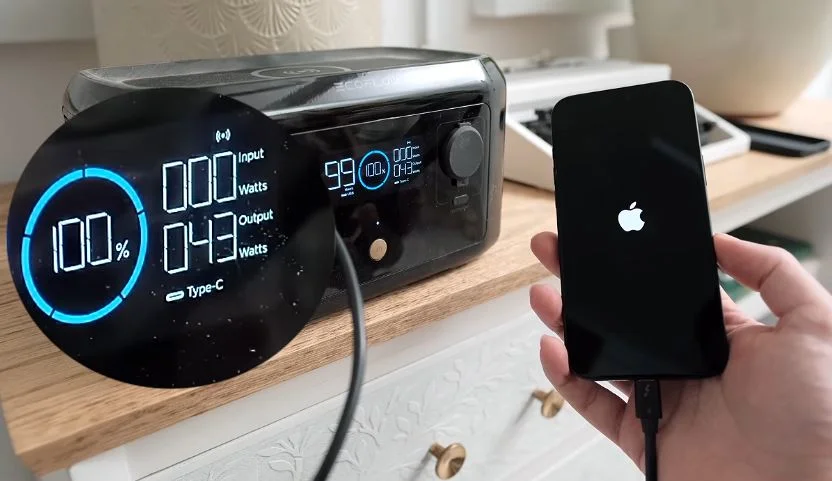
One catch worth knowing before you buy: hitting those numbers requires a 60W-or-higher adapter that supports USB PD 3.1 with Adjustable Voltage Supply — the charger that may have shipped with an older iPhone or a cheap third-party brick won’t get you there. If your current phone’s battery is already struggling, our guide to fixing fast battery drain after an iOS update is worth a look before you decide whether to upgrade or troubleshoot.
Camera: Variable Aperture Is the Headline, But Is It Worth It?
Apple borrowed a page from Samsung’s playbook here — a mechanical variable aperture on the main camera, something Samsung first shipped on the Galaxy S9 nearly eight years ago. On the iPhone 18 Pro Max, six laser-cut blades physically open and close the 48MP Fusion Main camera’s aperture, automatically adjusting between roughly ƒ/1.48 in low light and ƒ/4 for deep-focus group shots, with ƒ/1.8 as the default sweet spot for portraits. You can also take manual control of any of the four aperture settings through the new Pro controls in the Camera app.

In practice, I’ll say the same thing I keep telling friends who ask: the photos and videos out of this camera are genuinely good. Low-light shots in particular hold up better than I expected, and the new computational imaging pipeline keeps background detail crisp in group shots instead of turning it to mush. Video is some of the best I’ve seen out of a smartphone — not quite at the level of my mirrorless setup yet, but closing the gap every year.
The one place I was let down: the telephoto lens. I do a fair amount of wildlife photography on hikes, and the 0.5x–8x zoom range, while useful, left me wanting more reach for birds and distant animals. If Apple’s going to borrow Samsung’s variable aperture trick, I’d love to see it borrow Samsung’s longer periscope zooms next.


Apple also introduced a new feature called Apple Reference Image, which uses signed sensor data to create an unalterable “digital negative” of every photo you take — useful if you ever need to prove a photo hasn’t been edited. It’s opt-in, and honestly most people will never touch it, but it’s a smart move as AI-edited images become harder to spot.
Siri AI, iOS 27, and the AirDrop Speed Boost
The software side is where “it’s an iPhone” applies most literally — limited in some ways, genuinely useful in others. The standout for me, by far, has been the AirDrop speed boost in iOS 27. Apple claims transfers are up to 80% faster, and in my own testing moving a 30GB folder of raw video footage from the 18 Pro Max to my MacBook Pro, the whole transfer finished in under five minutes — something I’d never have attempted on an older iPhone without just plugging in a cable instead.

One important catch I ran into: that 80% speed gain only shows up when both devices are running iOS 27 or later. AirDrop to a friend’s phone still on iOS 26 quietly falls back to the old transfer speed — Apple doesn’t make this obvious anywhere in the UI. If AirDrop still isn’t cooperating for you, or you’d rather just plug in and go, our guide to transferring photos from iPhone to PC without iTunes covers the cable method too.

Siri AI rolled out in beta with iOS 27, and it’s Apple’s first genuinely overhauled Siri — pulling in personal context across messages, photos, and emails, plus “Siri mode” in the Camera app for asking questions about what’s in front of you. I’ve played with it, and it’s fun, but I’d honestly rather save the battery and processing for photos or actual work. It’s also worth knowing it’s a beta — mine occasionally misread on-screen text and needed the app relaunched before it would respond correctly, and it isn’t available to anyone under 13 or, at launch, to users in the EU.
How I Tested the iPhone 18 Pro Max
I bought my iPhone 18 Pro Max (512GB, Burgundy) at launch and used it as my only phone, running it side-by-side against an iPhone 15 Pro Max for battery, thermal, and charging comparisons. Testing covered daily messaging, social media, streaming, a graphically heavy mobile game for thermal testing, hiking photography, and large-file AirDrop transfers.
A few specific bugs and UX flaws I ran into, for transparency: the eSIM activation got stuck in an “Activating…” loop once after restoring from an iCloud backup, and needed a quick toggle of Airplane Mode plus a hotspot reset to resolve. The Camera app briefly froze for about a second when I rapidly switched between automatic and manual aperture mid-shot in low light. And as mentioned above, the AirDrop speed boost silently disappears when the receiving device hasn’t updated to iOS 27 yet, with no warning shown. None of these were deal-breakers, but they’re worth knowing about before you buy.
Should You Upgrade? A Breakdown by iPhone Generation
| If you own… | Our take |
|---|---|
| iPhone 12 or 13 | Upgrade. Battery, camera, and performance gaps are now huge. |
| iPhone 14 or 15 | Worth it mainly for battery life and the camera’s variable aperture. |
| iPhone 16 Pro Max | Optional — nice-to-have, but not a dramatic leap for most people. |
| iPhone 17 Pro Max | Skip this cycle unless you specifically want variable aperture. |
Not ready to commit to another iPhone at all? It’s worth stepping back and weighing the whole ecosystem question — we cover that in detail in our iPhone vs Android comparison. And if budget is the real deciding factor, Android still has genuinely strong options — our Samsung Galaxy A18 vs A17 comparison is a good starting point on the budget end of that spectrum.
Pros & Cons
✅ Pros
- Biggest battery life jump in iPhone history
- Dramatically faster wired charging
- Vapor chamber keeps the phone cool under load
- Variable aperture camera is genuinely capable
- AirDrop up to 80% faster (with iOS 27 on both ends)
❌ Cons
- $100 pricier across every storage tier than last year
- Telephoto zoom range still trails flagship Android rivals
- Siri AI is a beta, with real rough edges
- Needs a 60W+ PD 3.1 charger to hit top charging speeds
When to Call In a Professional
Most of the quirks above are software hiccups you can clear yourself with a restart or a quick settings toggle. But if your iPhone 18 Pro Max is physically overheating well beyond normal use, the battery is swelling, or a drop has cracked the display or camera glass, stop troubleshooting and get it looked at by Apple Support or an authorized technician rather than opening it yourself — Apple’s AppleCare+ coverage includes battery replacement and accident protection for exactly these situations. And if a nagging software issue follows you from an older phone — say, a muffled speaker or stuck-on-logo boot loop — our muffled iPhone speaker fix and iPhone stuck on Apple logo guide are both good first stops before you pay for a repair.
Keeping the new phone itself running smoothly is mostly about staying on top of storage and cache buildup — our guide to clearing cache on an iPhone is worth bookmarking now rather than waiting until things slow down.
FAQ
Is the iPhone 18 Pro Max worth buying?
Yes, especially if you’re upgrading from an iPhone 13 or older. The battery life, charging speed, and cooler-running chip are the most noticeable real-world improvements. If you already own an iPhone 16 Pro Max or 17 Pro Max, it’s a smaller leap.
How much does the iPhone 18 Pro Max cost?
It starts at $1,299 for 256GB in the US, rising to $1,499 (512GB), $1,899 (1TB), and $2,499 (2TB).
What’s the battery capacity of the iPhone 18 Pro Max?
Apple doesn’t officially publish mAh figures. Independent estimates put it around 5,400–5,500 mAh. Apple instead rates it at up to 45 hours of video playback on eSIM-only models.
Does the iPhone 18 Pro Max support variable aperture on every lens?
No — variable aperture is exclusive to the 48MP Fusion Main camera. The Ultra Wide and Telephoto lenses have fixed apertures.
How fast does the iPhone 18 Pro Max charge?
Apple says five minutes of wired charging provides around seven hours of video playback, and a drained phone can reach roughly 50% in about 15 minutes with a 60W-or-higher USB PD 3.1 adapter.
Is Siri AI available on the iPhone 18 Pro Max now?
Siri AI rolled out as a beta with iOS 27 in English first, with French, Japanese, Korean, Portuguese, and Spanish support added in October 2026. It isn’t available to users under 13 and wasn’t initially available in the EU.
Conclusion
The iPhone 18 Pro Max isn’t a flashy redesign, and it was never going to be. What it is, instead, is a phone where the unglamorous stuff — battery life, charging speed, and thermals — got meaningfully better, alongside a camera upgrade that actually changes how you shoot. If you’ve got an iPhone 12 or 13 sitting in your pocket, this is a genuinely great upgrade. If you bought last year’s Pro Max, there’s no urgency to jump again this cycle.

